BOOKS PUBLISHED
OUTTAKES ON BOB DYLAN: Selected Writings 1967-2021
Route Publishing (UK paperback, 2025)
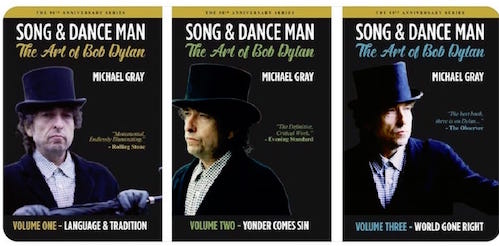
SONG & DANCE MAN: The Art of Bob Dylan
The 50th Anniversary Series, in three volumes:
Vol. 1 - Language & Tradition
Vol. 2 - Yonder Comes Sin
Vol. 3 - World Gone Right
The FM Press (US paperbacks and Kindle, 2023)
OUTTAKES ON BOB DYLAN: Selected Writings 1967-2021
Route Publishing (UK hardback, 2021)
HAND ME MY TRAVELIN' SHOES: In Search of Blind Willie McTell
Bloomsbury (UK hardback, 2007)
Bloomsbury (UK paperback, 2008)
Chicago Review Press (US hardback, 2009)
Chicago Review Press (US e-edition, 2009)
THE BOB DYLAN ENCYCLOPEDIA
Continuum International (US & UK hardback, 2006)
Continuum International (US & UK paperback & then updated paperback, 2008)
SONG & DANCE MAN III: The Art of Bob Dylan
Cassell Academic (UK hardback, 1999)
Cassell Academic (UK paperback, 1999)
Continuum (US hardback, 2000)
Continuum (US paperback, 2000)
Continuum International (UK & US p'back reprints, 2000, 2000, 2001, 2002, 2004, 2006, 2008)
THE ELVIS ATLAS: A Journey Through Elvis Presley's America
Henry Holt (US hardback, 1996) - co-authored by Roger Osborne
Chartwell Books Inc. (US hardback, inadequately revised edition, 2011) co-authored by Roger Osborne
MOTHER! The Frank Zappa Story
Proteus (UK paperback, 1985)
Cherry Lane (US paperback, 1985)
Arcana (Italian translation, paperback, 1986, titled ZAPP!)
Plexus (UK paperback, revised edition, 1993)
VGS (German translation, hardback, 1984, titled FRANK ZAPPA STORY)
Plexus (UK paperback, updated edition, 1994, 2001, 2007)
THE ART OF BOB DYLAN: Song & Dance Man
Hamlyns (UK hardback, 1981)
Hamlyns (UK paperback, 1981)
St.Martin’s Press (US hardback, 1982)
St.Martin’s Press (US paperback, 1982)
SONG & DANCE MAN: The Art of Bob Dylan
Hart-Davis-MacGibbon (UK hardback, 1972)
Abacus (UK paperback, 1973)
E.P.Dutton (US hardback, 1973)
Shobun-Sha (Japanese translation, hardback, 1973)
Route Publishing (UK paperback, 2025)
SONG & DANCE MAN: The Art of Bob Dylan
The 50th Anniversary Series, in three volumes:
Vol. 1 - Language & Tradition
Vol. 2 - Yonder Comes Sin
Vol. 3 - World Gone Right
The FM Press (US paperbacks and Kindle, 2023)
OUTTAKES ON BOB DYLAN: Selected Writings 1967-2021
Route Publishing (UK hardback, 2021)
HAND ME MY TRAVELIN' SHOES: In Search of Blind Willie McTell
Bloomsbury (UK hardback, 2007)
Bloomsbury (UK paperback, 2008)
Chicago Review Press (US hardback, 2009)
Chicago Review Press (US e-edition, 2009)
THE BOB DYLAN ENCYCLOPEDIA
Continuum International (US & UK hardback, 2006)
Continuum International (US & UK paperback & then updated paperback, 2008)
SONG & DANCE MAN III: The Art of Bob Dylan
Cassell Academic (UK hardback, 1999)
Cassell Academic (UK paperback, 1999)
Continuum (US hardback, 2000)
Continuum (US paperback, 2000)
Continuum International (UK & US p'back reprints, 2000, 2000, 2001, 2002, 2004, 2006, 2008)
THE ELVIS ATLAS: A Journey Through Elvis Presley's America
Henry Holt (US hardback, 1996) - co-authored by Roger Osborne
Chartwell Books Inc. (US hardback, inadequately revised edition, 2011) co-authored by Roger Osborne
MOTHER! The Frank Zappa Story
Proteus (UK paperback, 1985)
Cherry Lane (US paperback, 1985)
Arcana (Italian translation, paperback, 1986, titled ZAPP!)
Plexus (UK paperback, revised edition, 1993)
VGS (German translation, hardback, 1984, titled FRANK ZAPPA STORY)
Plexus (UK paperback, updated edition, 1994, 2001, 2007)
THE ART OF BOB DYLAN: Song & Dance Man
Hamlyns (UK hardback, 1981)
Hamlyns (UK paperback, 1981)
St.Martin’s Press (US hardback, 1982)
St.Martin’s Press (US paperback, 1982)
SONG & DANCE MAN: The Art of Bob Dylan
Hart-Davis-MacGibbon (UK hardback, 1972)
Abacus (UK paperback, 1973)
E.P.Dutton (US hardback, 1973)
Shobun-Sha (Japanese translation, hardback, 1973)
BOOKS EDITED
ALL ACROSS THE TELEGRAPH: A Bob Dylan Handbook
Sidgwick & Jackson (UK hardback, 1987) co-edited by John Bauldie
Futura (UK paperback, 1988) co-edited by John Bauldie
Time-Warner Books UK (paperback reprint of 1988 edition, 1993)
Sidgwick & Jackson (UK hardback, 1987) co-edited by John Bauldie
Futura (UK paperback, 1988) co-edited by John Bauldie
Time-Warner Books UK (paperback reprint of 1988 edition, 1993)
BOOKS CONTRIBUTED TO
ELVIS SPECIAL 1964
Albert Hand Publications, Heanor, Derbyshire (UK hardback, 1963)
Contribution: article 'First Person'
PONTEFRACT by J.S. Fletcher
S.R.Publishers, East Ardsley, Wakefield (hardback reprint edition, 1969)
Contribution: Inside jacket blurb
TARANTULA by Bob Dylan
MacGibbon & Kee, London (UK hardback 1st edition, 1971)
Contribution: Inside jacket blurb
JIMI by Curtis Knight
W.H. Allen, London (UK hardback 1st edition, 1974)
Swing Journal (Japan hardback, 1975)
Star Books (UK paperback, 1975)
Praeger (US hardback, 1975)
Praeger (US paperback, 1976)
Contribution: Ghost-writer. I turned it into sentences
RADIO 1 STORY OF POP
Octopus Books, London (UK hardback, 1974)
Contribution: essays on Bob Dylan and Elvis Presley
ENCYCLOPEDIA Of ROCK VOL. 1
Panther Books, London (UK paperback, 1976)
Contribution: entries on Tommy Steele and Elvis Presley
ENCYCLOPEDIA Of ROCK VOL. 2
Panther Books, London (UK paperback, 1976)
Contribution: entries on Jimi Hendrix and Frank Zappa
CONCLUSIONS ON THE WALL: New Essays On Bob Dylan
Thin Man Books, England (UK paperback, 1980)
Contribution: essay/memoir 'Sixteen Years'
NO DIRECTION HOME: The life and Music of Bob Dylan
by Robert Shelton
William Morrow, New York (US 1st edition hardback, 1986)
New English Library, London (UK hardback, 1986)
Penguin Books, Harmondsworth (UK paperback, 1987)
various subsequent editions
Contribution: reports commissioned by Robert Shelton on Blonde On Blonde and on Dylan bootlegs
100 YEARS ON RECORD
Rococo Publishing, London (UK paperback, 1989)
Contribution: Music Editor, and articles on Elvis Presley, Roy Orbison and Bob Dylan
THIRTY YEARS OF NME ALBUM CHARTS
Boxtree Books, London (UK paperback, 1993)
Contribution: the commentaries for the years 1962-1979
GOOD FOOD GUIDE 1994
Which? Books, London (UK paperback, 1993)
Contribution: three quotes published anonymously
BOB DYLAN: FUNFZIG JAHRE...
Germinal, Bochum (German paperback, 1993)
Contribution: essay on Dylan & the Blues - an early prototype for Song & Dance Man III Chapter 9
translated into German by Hein Versteegen
THE LITERARY COMPANION TO DOGS
Sinclair-Stevenson, London (UK hardback, 1994)
Contribution: list of 'Dogs Bob Dylan Seems To Have Abandoned'
reprinted from ALL ACROSS THE TELEGRAPH
THE COMPLETE NME ALBUM CHARTS
Boxtree Books, London (UK paperback, 1995)
Contribution: the commentaries for the years 1962-1979
ISIS ANTHOLOGY II
Chrome Dreams, New Malden (UK hardback & paperback, 2005)
Contribution: essay 'In Bob Dylan's Minnesota Footsteps'
ROUTLEDGE BLUES ENCYCLOPEDIA
Routledge, New York (US two-volume hardback, 2005)
Contribution: entry on Blind Willie McTell
THE MAMMOTH BOB DYLAN BOOK
Constable & Robinson, London (UK paperback, 2011)
Contibution: two Bob Dylan Encyclopedia entries
('Madhouse on Castle Street' and 'Masked & Anonymous')
REFRACTIONS OF BOB DYLAN:
Cultural Appropriations of an American Icon
Manchester University Press, Manchester (UK paperback, 2015)
edited by Eugen Banauch
Contribution: essay on 'Bob Dylan's Americanness in 1960s Britain'
LET THE DEVIL SPEAK:
Articles, Essays & Incitements, by Steven Hart
Black Angel Press (US paperback, 2015)
Contribution: back cover quote
IN DYLAN TOWN:
A Fan's Life, by David Gaines
University of Iowa Press (US paperback, 2015)
Contribution: back cover quote
BOB DYLAN DREAM:
My Life With Bob, by Roy Kelly
Pembury House Publishing (UK paperback, 2015)
Contribution: back cover quote
ROCK ‘N’ FILM:
Cinema’s Dance with Popular Music, by David E. James
Oxford University Press (US hardback, 2016)
Contribution: back cover quote
PROFESSING DYLAN
edited by Frances Hunter
PhillipsMemphis Publishing (US paperback, 2016)
Contribution: Foreword
BUZZCOCKS: THE COMPLETE HISTORY
by Tony McGartland
John Blake Books (UK paperback, 2017)
Contribution: two photographs
AGAINST MISERABILISM
by David Widgery
Vagabond Voices (UK paperback, 2017)
Contribution: back-flap author photograph also used inside
VISITING BOB: Poems Inspired by the Life and Work of Bob Dylan
ed. Thom Tommaro & Alan Davis
New Rivers Press (US paperback, 2018)
Contribution: back cover quote
THE TRUE PERFORMING OF IT: Bob Dylan & William Shakespeare
by Andrew Muir
Red Planet Publishing (UK paperback, 2019)
Contribution: back cover quote
SALON 188 BIS HEUTE: Anthologie und Dokumentation
Various authors; ed. Rainer Vesely & Bernhard Widder
SalonPresse (German paperback, 2019)
Contribution: short essay
NEW APPROACHES TO BOB DYLAN
Various authors: ed. Anne-Marie Mai
University of Southern Denmark Press, Odense (Danish paperback, 2020)
Contribution: essay based on University of Southern Denmark keynote conference paper
DYLAN AT 80: It Used To Go Like That, And Now It Goes Like This
Various authors: ed. Gary Browning & Constantine Sandis
Imprint (UK paperback, 2021)
Contribution: essay 'The Finishing End?'
BOOKS READ 2024
TRANSCRIPTION, Kate Atkinson, 2018 Tagged quite rightly as a spy novel that challenges the genre, this is a marvellous book, set mostly during WWII and in London. It more than once reminded me of Elizabeth Bowen, though I'd recommend it in any case for its civilised complexity and sharply playful interest in English idiom. Perhaps there's a touch of "Dance To The Music Of Time" to it too [see below], but also, in its way, it has quite a strong plot. I have no idea how Atkinson can be so prolific a writer, but she is.
BACK WHEN WE WERE GROWNUPS, Anne Tyler, 2001 Yes, Anne Tyler again: and if you've never read one of her novels, this would be an entirely representative one to investigate. It sags a bit sometimes but not for long or often, and mostly it rattles along displaying her rare ability to knife the ways people in middle-class families treat each other while managing to move the reader as the same time as flashing that knife.
THE THREE HOSTAGES, John Buchan, 1924 I enjoyed the more famous Richard Hannay adventure The Thirty-Nine Steps in my youth (and the original film version); that book was so vivid. I failed to keep reading this one after only ten pages, though. The edition I picked up includes an introduction by Christopher Hitchens, and he does his best to defend Buchan against the usual charges of gung-ho imperialism, racism, snobbery and the rest - but really, a hundred years ago, were upper middle class Britons quite so insufferably pompous, slow-witted and smug as this?
" 'Yes. They'll murder them in cold blood - three innocent people - and then swing themselves with a lighter mind. I know the type....
'Good God!' I cried. 'It's a horrible thought.'...The whole story seemed to me incredible, and yet I could not doubt a syllable of it when I looked at Macgillivray's earnest face."
THE CHILDREN ACT, Ian McEwan, 2014 A slim novel about a British Family Court judge, her work and her home life. Her mental and emotional responses to finding she has a newly problematic marriage never convince, and yet this occupies the book's long opening section. You read it aware of McEwan's calculations and cleverness, but unable to believe in his main character. Yet there are brilliant passages - as when she visits a teenage boy who is refusing to have a blood transfusion; it's a sequence in which the boy's precocious brilliance, the judge's kindness and restraint, the quick shifts in mood and the mutual enjoyment of their ecounter is all done superbly well.
BLACKTOP WASTELAND, S.A. Cosby, 2020 Violent Black American crime and fast cars novel of no particular merit. Good on handling its plot, but the occasional attempts to seem a bit more literary than that are laughable.
CROOKED LETTER, CROOKED LETTER, Tom Franklin, 2010 Well-written thriller really about loneliness and cruelty; set in an empty small-town patch of Mississippi.
A LONG WAY FROM VERONA Jane Gardam, 1971 An early and highly distinctive Gardam novel, written beautifully from inside the mind of a naive 13-year-old girl. Remarkably alive.
SYCAMORE ROW, John Grisham, 2012 Not for the first time, I was reduced to finding books in a charity shop and picked this; it's a long novel - long enough to make you appreciate how hard he works when he's writing - and superbly plotted... until it reaches its slightly implausible denouement.
WE ARE ALL COMPLETELY BESIDE OURSELVES, Karen Joy Fowler, 2013 This novel begins with a sharp relish of the comedy of modern sophomore life, and then shifts backwards to offer well observed and sometimes moving scenes of family life when the heroine is growing up, but as the book progresses it becomes clear that the author has an axe to grind - i.e. the cruelty of a particular US period when individual chimpanzees were brought up within middle-class nuclear families - and long before the end everything else has been ditched to concentrate on the grinding of this axe.
BURNING BRIGHT, Helen Dunmore, 1994 I have no idea how so much life and action, such sharply varied, fresh characters, so many worlds, and such likeable, humane intelligence, can all be packed into what looks so slim a novel. The past and present intertwine as an old lady and a sixteen-year-old girl form an unpredictably fruitful alliance as both fight to survive on their own terms. I've read many of Dunmore's novels and admired most, and though memory is unreliable, this is surely her best.
CASE HISTORIES, Kate Atkinson, 2004 I'm surprised and disappointed at how much less good this detective novel proved to be than her fine spy novel "Transcription". Mildly entertaining but by no means on a par.
THE GIRL BEFORE, J.P. Delaney, 2017 Despite some doubts induced by the occasional implausibity, this is the most ingeniously constructed, beautifully engineered psychological thriller I think I have ever read. I found it in a giveaway pile, not knowing it had been a New York Times best-selling novel. It's truly compelling and a hugely enjoyable read.
SLAM, Nick Hornby, 2007 The narrator starts out as an almost-16-year-old boy, rather brighter than he says he is. The beginning, by accident or design, is a pale echo of the famous opening of Catcher In The Rye, and Hornby is no Salinger. It grows into a very likeable novel, though. Written when the author was 50, it's quite something to have created a plausible adolescent mindset, and we get a particularly brilliant early scene in which he first meets a future girlfriend and they have a sharp and funny flirtatious conversation. There are other sections - mostly those that plunge us into a sort of false future - that work far less well, and towards the end it all sometimes seems a bit fluffy, but overall it's fresh and shrewd.
DO NO HARM, Robert Pobi, 2022 That primitive need to know what happens and who dun it kept me reading this long, awful book. Its whole tone rubs an almost Trumpian level of childish boastfulness in your face, while examples of bad writing are on every page, very often in clumsy and silly similes, along with an awkward parading of bytes of esoteric knowledge and brand names. It's no surprise that the hero has high-tech supernatural powers, and that every attempt to give him a family life is an unconvincing bore.
CAPITAL CRIMES NASHVILLE, Faye & Jonathan Kellerman, 2006; CAPITAL CRIMES BERKELEY, Faye & Jonathan Kellerman, 2006 Two short whodunits in one volume, both co-written by what the blurb insists is "a happily married couple". Both books have an almost endearingly old-fashioned quality to them, though nothing to make you forgive the smug-as-only-Americans-can-be quality of all the characters who are neither obvious baddies or murderers. Spoiler alert: both dunits were by women. Why is it that so many fictional murderers are women, when in real life over 90% of killers are men? I'd like Ann Cleeves to answer this, for a start.
A QUIET FLAME, Philip Kerr, 2008 Early on there is some nasty violence, not lingered over but detailed, and sometimes some clumsy prose, but this is a powerful novel by an author so prolific in his shortish life (he died at 62 and had written 30 novels, 10 children's novels and two volumes of non-fiction) that it astonishes me how good it is. It has a striking and alluring opening and grows into a substantial work and a committed indictment of how the Nazis came to power, and of their later conduct, and of the Peronist regime in Argentina that welcomed and used them. This is built upon formidable research into 1930s Berlin and 1950 Buenos Aires. The narrator is his German detective Bernie Gunther, who features in 13 other novels. Bernie has some good one-liners, which is why Kerr has been compared to Raymond Chandler. I'd recommend this novel to anyone who doesn't mind it having less subtlety than Proust.
WHO'S THERE?: Travels in Place and Time, Simon Loftus, 2024 A slim volume partly of bits of history but mostly of travel essays, by a confident writer and wine merchant. One of the latter pieces is about the Gers, the very part of France I've been living in for the past 16+ years; it's a fond but slightly idealised portrait of it, and there's a hint of the rose-tinted in his writing about other places, though this tends to be endemic in travel writing, and is probably what makes it popular.
IF THE DEAD RISE NOT, Philip Kerr, 2009 This is the next Bernie Gunther novel in the series, and shifts him to slightly later times and a new place of exile: it begins in 1934 Berlin and moves to Havana in 1954. I think it less good - a tad cruder in the hero's sexism of the day, and with a less appealing revisit to the same main female character - but it may also be that 'A Quiet Flame' had been my first plunge into his world, so that with this one the level of Kerr's historical research surprised and thus impressed me less. That research is still worn lightly and his plotting is at least as ingenious this time around.
THE REDRESS OF POETRY, Seamus Heaney, 1995 A selection of lectures delivered during his time as Oxford Professor of Poetry in the early 1990s (though some seem far too long to have been delivered as lectures, and read as essays). Like T.S. Eliot and D.H. Lawrence, we have in Heaney another great creative writer who also values being a literary critic - and he's a fine one: a bit hard on Larkin and a tad soft on Elizabeth Bishop, but very fair towards out-of-fashion Dylan Thomas, acute on Wilde's 'Ballad of Reading Gaol', wonderful on John Clare and articulate on the unavoidable divides in the minds and lives of Irish writers. Alert to, and recurrently choosing, the most alive and resonant of words, he offers the redress achieved when "imagination can press back against the pressure of reality".
DIPLOMATIC BAGGAGE, Brigid Keenan, 2005 This fashion journalist has a huge gang of friends willing to swear black is white and that this twee, feeble nonsense is in fact "hilarious", "fabulous" and that she "writes like a dream". Hopelessly pleased with its own supposed amusingness. I couldn't take much of it. As worthless a book as I've ever tried to read. William Dalrymple, Shirley Conran, Joceline Dimbleby, Joanna Lumley and others should be ashamed of themselves for bigging up such privileged trivia.
DEATH ON THE PONT NOIR, Adrian Magson, 2012 This is a crime novel set in the early 1960s, and mostly in Northern France, involving British gangsters, French police and other authorities, and the likelihood of an assassination attempt against President de Gaulle. The hero, as in several other books by Magson, is French detective Lucas Rocco, a very decent chap. The storyline kept me reading the book despite its being very badly written.
SMILEY'S PEOPLE, John le Carré, 1980 Perhaps surprisingly I'd never read a Smiley before, despite the familiarity of the best-selling books and TV series. Nor did it matter that the previous volumes in the series were unread: this is fairly complete in itself. The writing seemed patchy - sometimes taking ten sentences where one would have sufficed, yet more frequently offering sustained passages of rather beautiful prose, hung on a plot that must have taken a vast amount of work to devise. Yet what I liked most within that plot was its extraordinary, splendid attention to minutiae.
FOOL ME ONCE, Harlan Coben 2016 Another multi-million-selling author I've never read before. The dedication at the start should have been off-putting enough: "For Charlotte: Doesn't matter how old you get, you're still my little girl." This murder mystery seems to me to embody almost everything that's wrong with American culture, even to the extent that real people pay to have their real names used as the names of characters within it! It's a blandly privileged world, very pro-guns, exploitatively solemn about "our troops" in foreign wars, and has a hugely dislikeable, crass main character. The plot demands a major suspension of disbelieve - and yet, and yet, with an uncanny authorial skill, he kept me reading it quite swiftly right to the end. He knows what he's doing.
RED DRESS: Poems, David Cameron, 2023 This is a slim volume of poetry, and laid out with pleasing blank space on each page - but it brims over with eloquent feeling, turmoil and sadness, mostly about failing love, so that to read it is as rich an experience as prose fiction a hundred times longer. It packs a punch, over and over again, because Cameron loves to end a poem with a verbal landmine, reshaping its terrain. This is never done cheaply, and part of the discretion with which he achieves it lies in his attentive interest in creating - he might say unearthing - double meanings in terms we use by habit in only one way. This is punning on a high level, and this attentiveness to words is echoed by how he alludes to others' writing - a touch of E.M. Forster, several nods to Bob Dylan.
DON'T MENTION THE NIGHT: A Memoir, David Belbin, 2022 This is the Nottingham-based story of Belbin's youth, told through his teen and post-teen devotion to the work of Nick Drake, Kevin Coyne (whom he interviewed) and the later band Gaffa (whose members he knew). It's thoughtfully written, self-revealing about his own depression and drugs usage, and understandably over-keen on the self-absorbed songs of Drake and Coyne. It's considered and carefully crafted, but the only humour is supplied by the lyrics in Gaffa's songs, and some of his own would have been welcome.
VICTORY, Joseph Conrad, 1915 This novel, the meaning of its title word always opaque in this context, begins with a distinctly comic style and mood I hadn't expected, but a tension builds, slowly yet so powerfully, and with such attentive detail to the main characters' subtleties of character, that the last third of the book is one of the most heart-in-mouth dramas I've ever read. A unique major work of fiction.
DANCE TO THE MUSIC OF TIME, Anthony Powell, 12 volumes (1951-1975) I've just read this for the third time, about 50 years after I first encountered it. This time I read it by alternating each volume with reading another book. In the course of his 12, Powell takes us from the narrator's schooldays and adolescence, a WWII spent in the army yet entirely in Britain, a young adult's life and career as a novelist & book reviewer in privileged spheres of upper-class and bohemian English life, through marriage and on up towards the age of 70 at the end of the 1960s. It has many faults Powell would have been unapologetic about: sexism, racism, effete snobbery and an interest in many other people's "sexual tastes" (his phrase) that manages to sound both coy and prurient. Weirdly, too, despite the near fixation about his other characters' lives and actions, when the narrator marries a sister of one of the families we've encountered, he merely tells us they've married: nothing of their courtship, or even feelings, and almost no glimpse into it at all ever afterwards - a perverse dodging of the scrutiny his other portrayals receive. But, carrying a huge counterweight to all that, the voice is that of an attractively intelligent, highly educated man of generous instinct, his interest in other people acute, articulate and often very funny, and structurally the series is masterly, Powell's vast cast of characters - characters who change, grow, re-style themselves and/or decay - coming, going and re-aligning many times over with inspired dexterity of plot across the many decades of the story. It amounts to one writer's monumental portrayal of the 20th Century.
THE QUEEN OF THE TAMBOURINE, Jane Gardam, 1991 Not for the first time, beginning a Gardam novel, I felt it was unpalatably facetious, its humour too cruel - but, also not for the first time, I found how compellingly it deepened into a moving portrait of a passionately interested and interesting woman's struggles, always buoyed up by energy and an acerbic wit, and in the end a book of great originality. Its not so minor pleasures are the writer's love of the surprising epithet and simile. This is one of very many that don't show off but do hit the spot: "Then up the [Rathbone] Road came Old Bernard on his bike, knees out sideways like a grasshopper..."
THE WATERWORKS, E.L. Doctorow, 1994 judging, admittedly, by this novel alone, I can't buy the American assessment of the late great Doctorow as the great US novelist, the Pulitzer prize winner and so on. There's a disconnect between the reputation and the prose on offer here, in which the narrator is a mid-C19 NYC newspaper editor. He gives a vivid picture of time and place, but is often prone to ponderous Great Thoughts and a quaint fuddyduddy chattiness that sits uneasily with his profession and the story. There's also a disconnect between the book's blurb and its reality, the one lipsmacking about how "every form of crime and vice flourishes" as we're taken "into the darkest heart of evil and avarice", and the other starting with almost 200 pages of sedate descriptions and civilised conversations between decent men (and the occasional saintly woman). And Doctorow never bothers to decide whether a clause should end with a full-stop, semi-colon or colon, and uses dot-dot-dot instead, all the time. Dot-dot-dot can be effective and telling, used with reticence - but 16 times on one short page? Over and over on every page? No.
WHEN WILL THERE BE GOOD NEWS?, KATE ATKINSON, 2008 This is another of her genre-challenging detective novels featuring ex-detective Jackson Brodie, a man seriously blemished by his oblivious sexism - and it is SO much better than Case Histories from four years earlier. This one is marvellous - her mix of dark and resourceful good cheer, her joy in being so alertly playful with language - is integrated into a complex, ingenious plot. And what really makes the book shine brightest is the characters she's created, and especially that of a 16-year-old girl who is just admirable in every way - and not by being, as charistmatic fictional teens so often are, rebellious and challenging, but by being genuinely good, with a genuine love of literature and a huge, warm, humane spirit.
LAST TRAIN FROM LIGURIA, Christine Dwyer Hickey, 2009 I have such different responses to this Irish novelist's books. Cold Eye of Heaven was gloomy but compelling and humane; The Narrow Land was full of spiteful unpleasantness; Last Train From Liguria, published ten years earlier than that one, has been the finest novel I have read all year - one of the most beautiful books I can ever remember reading. Set partly in Dublin and partly in London, it is mostly set in a seaside town on the Ligurian Riviera in Italy in the 1930s, as Mussolini and his fascism are infecting the country and endangering those who are Jewish and, as with some of the book's main characters, half Jewish and long unaware of it. A vivid setting and a very moving story, with the main character's love of Italy balanced poignantly against the creeping onset of that fascism and its infecting of ordinary people, evoked so effectively - which now, thanks to Trump, our very own Mussolini, is so timely.
THE ULTIMATE GOOD LUCK, Richard Ford, 1981 I have always admired the Ford novels I've read - the usual ones - but struggled to find much to redeem this one. The characters seem opaque, the storyline thin and the mechanics of the prose obtrusive. He overdoes hugely this sort of thing: "...a sense of lucklessness swam in the air around him", and, "air with risk in it, palpable and utterly in the present, and going right into it made him feel lucky..." If it isn't the air being significant in unspecific ways it's the light. The light made him feel this or that, but without narrative clarity, and offered with mere assertion. A thin novel.
BIG SKY, Kate Atkinson, 2019 As you can tell, I like Atkinson's novels - but not all of them. This starts so poorly - so garrulously shallow, overly casual, a bit pleased with itself - and goes on to redeem itself only partially and only by the pull of its crime-story plot. I wanted to admire this book, because in it, eleven years after first creating the excellent Reggie Chase, she brings her back; yet she wastes her reappearance. If you hadn't read When Will There Be Good News? (a far shorter, tighter novel), you'd barely notice her in this one. Similarly, we get a new, likeable young character here - Harry - and just when he looks set to really come into his own, he fades from sight. Lastly, she indulges in truly boring recurrent scenes backstage at a cheap variety show in Bridlington, featuring a comedian, a drag artist and a magician, none of whom have anything to do with the plot.
CLOSING TIME, Joseph Heller, 1994 I've rarely liked a book as much as I liked Catch-22, which I read as soon as it was published in a UK paperback edition (and which I still have, and had decided to re-read for the first time, just before coming across this, subtitled The Sequel to Catch 22). Ah, and it starts so well: sustained opening pages of thoughtful, wide-ranging, beautiful prose. But about 50 pages further in, I had to give it up. Too much was too implausible, bitty and tiresome. It seems a graceless verdict, I know, but the truth.
BOB DYLAN: PROPHET WITHOUT GOD, Jeffrey Edward Green, 2024 From the offputting title to the early scattering of words like "normativity", this is not a book with immediate appeal; but its theme is plausible and distinctive: that Dylan's work and life offers three phases of philosophical thrust: first the struggle for liberty and social justice without religious authority; then the submission to that religious authority and God; and then the struggle for balancing all this after the religious fervour has died back. "Accordingly, the primary category from which this work approaches Dylan is prophet." And "this book treats Dylan in light of the fact that he not only has lived, written, sung, spoken, filmed, and performed, but done so in tandem with a mass audience that, more so than in the case of any modern artist, has understood his life's work as having an oracular significance." I disagree. It's a huge presumption that Dylan has understood his life's work to have had that, or any specific other significance, and especially that any such understanding has consciously shaped his work, though it seems clear that he has felt burdened by fame and the expectations set up by the brilliance of his early work.
THE TRUMPET-MAJOR, Thomas Hardy, 1880 Hardy's only historical novel, categorised by him as one of his Romances and Fantasies, and set on the Dorset coast during the Napoleonic Wars when invasion of England was expected and greatly feared. It may not be one of his best, but it's very skilled, very articulate, brilliantly plotted and with main characters sensitively and warmly handled. There's a deal of comedy in it too, not least in the sardonic portrayal of people's foibles in general and the story's one outrageous baddie - a splendid creation not unlike Milne's Bad Sir Brian Botany. And then, though the heroine is a bit pallid, the love story is affecting enough that at the end [SPOILER ALERT] it delivers a shock that made me want to shout "No!" in the way that many of us did in the middle of David Nicholls's "One Day".
CROOKED HOUSE, Agatha Christie, 1949 As good a whodunit as she ever wrote. Crude characterisation, of course, and some improbability of action, but there are no sneaky last-minute relevations about secret cousins: the reader is told everything through the eyes of a calm narrator, and yet this reader at least, while knowing at once that the false ending was a false ending, still never felt I knew who the real murderer was until this was revealed at the very end, and perfectly plausibly.
______________